The Problem with Perseus and Medusa Imagery
• Roopesh Singh
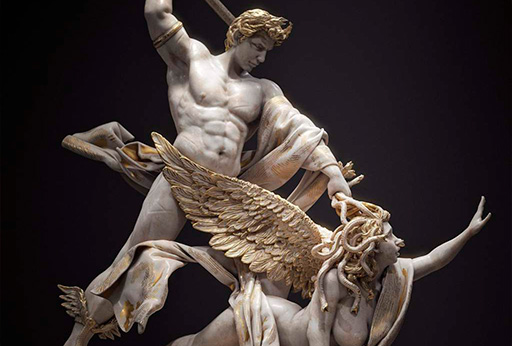
Perseus and Medusa in the act. Inspired by Canova’s sculpture.
The Paradox: Why the Perseus-Medusa Imagery Fails as a Symbol for International Falsely Accused Day
I recently found myself in a debate regarding the visual symbols adopted for International Falsely Accused Day. My interlocutor was convinced that a sculpture of Perseus triumphantly wielding Medusa’s severed head was a perfect fit. I strongly disagree. Adopting this imagery without deep philosophical reflection is profoundly problematic.
My critique is rooted in an abstract, structural idea rather than contemporary gender politics. It concerns the core message carried by the modern survival of the myth. This imagery delivers a sobering message, an archetype of absolute innocence, which we can interpret as pure justice, is systematically punished in our mortal world. Whether intentionally or not, centuries of storytelling and artistic depiction have reinforced this tragedy. Yet, it also forces us to reflect on a deeper truth, the nature of absolute beauty cannot have its clarity obscured, no matter how a specific era attempts to reshape the narrative.
Injustice in Three Acts
The manifestation of injustice is perpetual. We can trace its evolution across a three-act historical journey from antiquity to the modern era.
Act I: The Ancient Injustice
In classical Greek mythology, Medusa is initially defined by a compelling beauty that allures everyone, not out of a desire to manipulate, but by her mere existence. This beauty is violated by Poseidon within the temple of Athena. The ancient writers deliberately chose this setting; by placing the violation inside the sanctuary of the goddess of wisdom and justice, they introduced a chilling subtext. Medusa endures her foundational trauma at the very altar where she should have found sanctuary, forcing us to question not only the crime itself, but the systemic institutions supposed to deliver justice.
Act II: The Medieval Vilification
During the Roman era, the poet Ovid reframed the myth, transforming Medusa’s beauty into literal monstrosity. Here, a secondary layer of injustice is born: the original trauma is erased, and the victim is recast as a monster. Despite this devastating narrative inversion, the underlying reality of her innocence survives. This enduring core is not passive; it functions as an active, uncontainable power that resists historical erasure, waiting to be reclaimed by future generations.
Act III: The Modern Reinterpretation and Meta-Critique
Modern artistic reinterpretations, specifically those inspired by Antonio Canova’s Neoclassical sculpture, have stripped away the medieval distortion to reclaim Medusa’s innocence, restoring her from Roman ugliness back to her original, classical grace. This shift proves that the truth of her core identity survived both Roman vilification and the ancient failure of Athena’s temple. By restoring her aesthetic harmony, the modern artist actively dismantles centuries of historical injustice.
Crucially, this reclamation acts as an intervention. The artwork captures Perseus mid-assault; the blade is raised, but the execution is frozen in a perpetual time capsule. On a meta-analytical level, this choice upends the entire traditional narrative. By rendering Medusa as visibly innocent rather than monstrous, the artist forces the viewer to interrogate the “justice” being meted out by Perseus.
Perseus’s clean, heroic form becomes a false front for systemic failure, mirroring Athena’s original betrayal in the ancient myth. By freezing the act prior to its violent completion, the imagery invites us to critique the apparatus of justice itself. Medusa remains trapped, a historical victim of shifting narratives, and a visual victim in the art piece, condemned to bear injustice elegantly for eternity.
Conclusion: The Semiotic Collapse
The necessary intellectual resolution is clear: we must liberate Medusa and the abstract innocence she represents.
If this imagery is deployed as a poster for International Falsely Accused Day under the assumption that Medusa represents the falsely accused, we are forced into a terrible logical corner. To celebrate her decapitation is to celebrate the ultimate triumph of a lie. Conversely, if Perseus is meant to represent the triumph of justice, we are celebrating a deeply broken system that executed an innocent casualty.
No matter how you slice the allegory, utilizing a brutal beheading to symbolize the protection of the innocent is a profound narrative failure.